

Supplier name: HealthRota
Publication date: 10/06/2026
Commitment to achieving Net Zero
HealthRota is committed to achieving Net Zero emissions by 2045.
Baseline Emissions Footprint
Baseline emissions are a record of the greenhouse gases that have been produced in the past and were produced prior to the introduction of any strategies to reduce emissions. Baseline emissions are the reference point against which emissions reduction can be measured.
| Baseline Year: 2024/25 | |
| Additional Details relating to the Baseline Emissions calculations. | |
| Our first full organisational footprint was completed for 01 Apr 2024 – 31 Mar 2025; this is therefore our baseline year. We have no scope 1 or 2 emissions as we do not own or operate any buildings or vehicles. The office we operated out of during the reporting period was a shared office space and therefore has been accounted for in Scope 3 – Upstream Leased Assets. | |
| EMISSIONS | TOTAL (tCO2e) |
| Scope 1 | 0.0 |
| Scope 2 | 0.0 |
| Scope 3 | 52.94 |
| 3.1 Purchased goods and services | 28.56 |
| 3.2 Capital goods | 1.46 |
| 3.4 Upstream transportation and distribution | 0.02 |
| 3.5 Waste generated in operations | 0.83 |
| 3.6 Business travel | 7.35 |
| 3.7 Employee commuting | 7.83 |
| 3.8 Upstream leased assets | 6.89 |
| Categories 3, 9-15 | Not Relevant |
| Total Emissions | 52.94 |
Current Emissions Footprint
As this is our first year measuring and reporting emissions the current reporting period is identical to the baseline; figures are shown in kilograms and tonnes below for transparency with the data supplied.
| Reporting Year: 2025/26 | |
| EMISSIONS | TOTAL (tCO2e) |
| Scope 1 | 0.0 |
| Scope 2 | 0.0 |
| Scope 3 | 62.22 |
| 3.1 Purchased goods and services | 44.35 |
| 3.2 Capital goods | 0.03 |
| 3.4 Upstream transportation and distribution | 0.06 |
| 3.5 Waste generated in operations | 1.19 |
| 3.6 Business travel | 0.60 |
| 3.7 Employee commuting | 4.97 |
| 3.8 Upstream leased assets | 11.02 |
| Categories 3, 9-15 | Not Relevant |
| Total Emissions | 62.22 |
Emissions reduction targets
In order to continue our progress to achieving Net Zero, we have adopted the following carbon reduction targets.
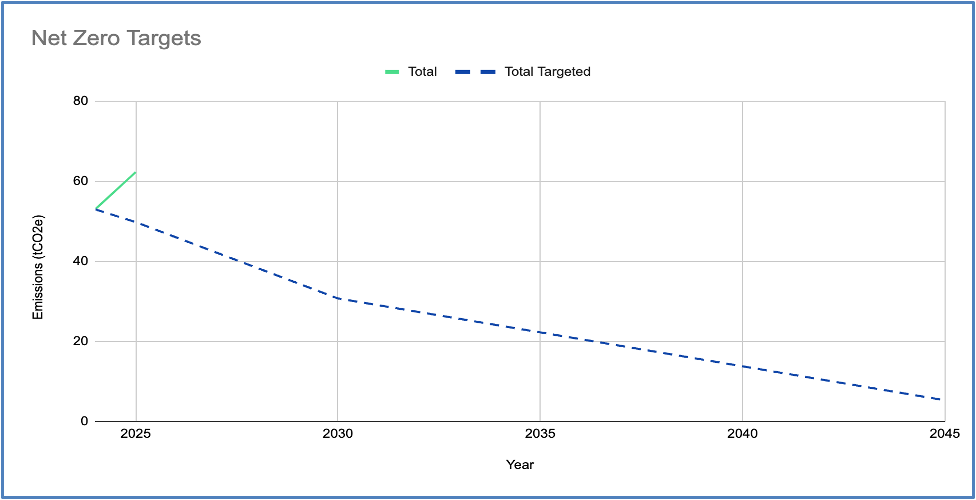
HealthRota commits to reducing scope 1, 2 and 3 emissions by 42% by 2030 from a 2024/25 baseline.
HealthRota commits to reducing scope 1, 2 and 3 emissions by 90% by the net zero target year 2045 from a 2024/25 baseline.
Progress against these targets can be seen in the graph below:
Carbon Reduction Projects
Completed Carbon Reduction Initiatives
We actively encourage sustainable travel behaviours. Our cycle-to-work scheme is well utilised by employees, and we support the use of shared and low-emission transport options, including UK-based shared cycle schemes. Where commuting is required, we encourage walking, running, cycling and public transport use, with no employees currently commuting by private car.
Our working environment also supports sustainable choices. In 2024, we relocated to a shared office space designed to improve energy efficiency, including increased use of natural light and LED motion-responsive lighting. The building also promotes responsible waste management through segregated recycling facilities in both communal and dedicated areas, supporting employees to adopt sustainable behaviours in day-to-day operations.
We have undertaken a comprehensive optimisation of our AWS environment, focusing on reducing the use of CPUs, storage capacity and underlying infrastructure through improved workload design and resource management. This includes right-sizing compute resources, removing underutilised services, and implementing more efficient scaling practices.
These changes reduce the amount of energy required to run our systems, as cloud sustainability is directly linked to efficient resource utilisation and reduced energy demand. By eliminating idle and excess capacity, we minimise waste and contribute to lower carbon emissions associated with our digital infrastructure.
We achieved significant reductions in several categories, particularly those more directly influenced by employee behaviour and operational decision-making. Business travel fell by 91.8%, reducing from 7.35 tCO2e to 0.60 tCO2e, while employee commuting decreased by 36.6%, from 7.83 tCO2e to 4.97 tCO2e. Capital goods also reduced substantially, falling from 1.46 tCO2e to 0.03 tCO2e, reflecting much lower equipment-related emissions during the reporting year. However, these improvements were outweighed by the increase in Purchased Goods and Services and higher upstream leased asset emissions.
Although absolute emissions rose from 52.94 tCO2e to 62.22 tCO2e, carbon intensity dropped 10% from 4.07 tCO2e per employee to 3.66 tCO2e per employee showing efficiency in our operations.
In the future we will implement the following measures:
Webhosting
- Track kg CO2e per workload using AWS Customer Carbon Footprint Tool, Azure Emissions Impact Dashboard or Google Cloud Carbon Footprint, and make optimisation a KPI.
- Turn off or shrink servers, test environments and databases when not using them to avoid wasting power.
- Move old or rarely used files into low-energy archive storage and delete data we no longer need.
- Use serverless services so functions and databases only run when something actually happens, rather than sitting idle consuming power.
- Write lean code and tidy up queries so each task finishes quickly and needs less computing time.
- Group short tasks together and share resources so one server handles several jobs instead of many half-empty ones.
- Negotiate cloud-provider contracts that specify renewable-energy-matched data centres and provide location-based emissions data.
Travel
- Integrate a travel-approval workflow that defaults to virtual meetings and rail in preference to air.
- Promote a cycle-to-work salary-sacrifice scheme and subsidise season tickets to lower commuting emissions.
Goods
- Extend hardware refresh cycles to four years and pilot device-as-a-service leasing to capture end-of-life materials recovery.
- Request suppliers to disclose cradle-to-gate product carbon footprints and set reduction targets.
Office space
- Collaborate with the serviced-office landlord to introduce sub-metering and renewable energy.
Declaration and Sign Off
This Carbon Reduction Plan has been completed in accordance with PPN 06 and associated guidance and reporting standard for Carbon Reduction Plans.
Emissions have been reported and recorded in accordance with the published reporting standard for Carbon Reduction Plans and the GHG Reporting Protocol corporate standard[1] and uses the appropriate Government emission conversion factors for greenhouse gas company reporting[2].
Scope 1 and Scope 2 emissions have been reported in accordance with SECR requirements, and the required subset of Scope 3 emissions have been reported in accordance with the published reporting standard for Carbon Reduction Plans and the Corporate Value Chain (Scope 3) Standard[3].
This Carbon Reduction Plan has been reviewed and signed off by the board of directors.
Signed on behalf of the Supplier:

Julian Webb
Client Director and Leadership Team Member
10 June 2026
[1]https://ghgprotocol.org/corporate-standard
[2]https://www.gov.uk/government/collections/government-conversion-factors-for-company-reporting
[3]https://ghgprotocol.org/standards/scope-3-standard
Previous Carbon Reduction Plans: